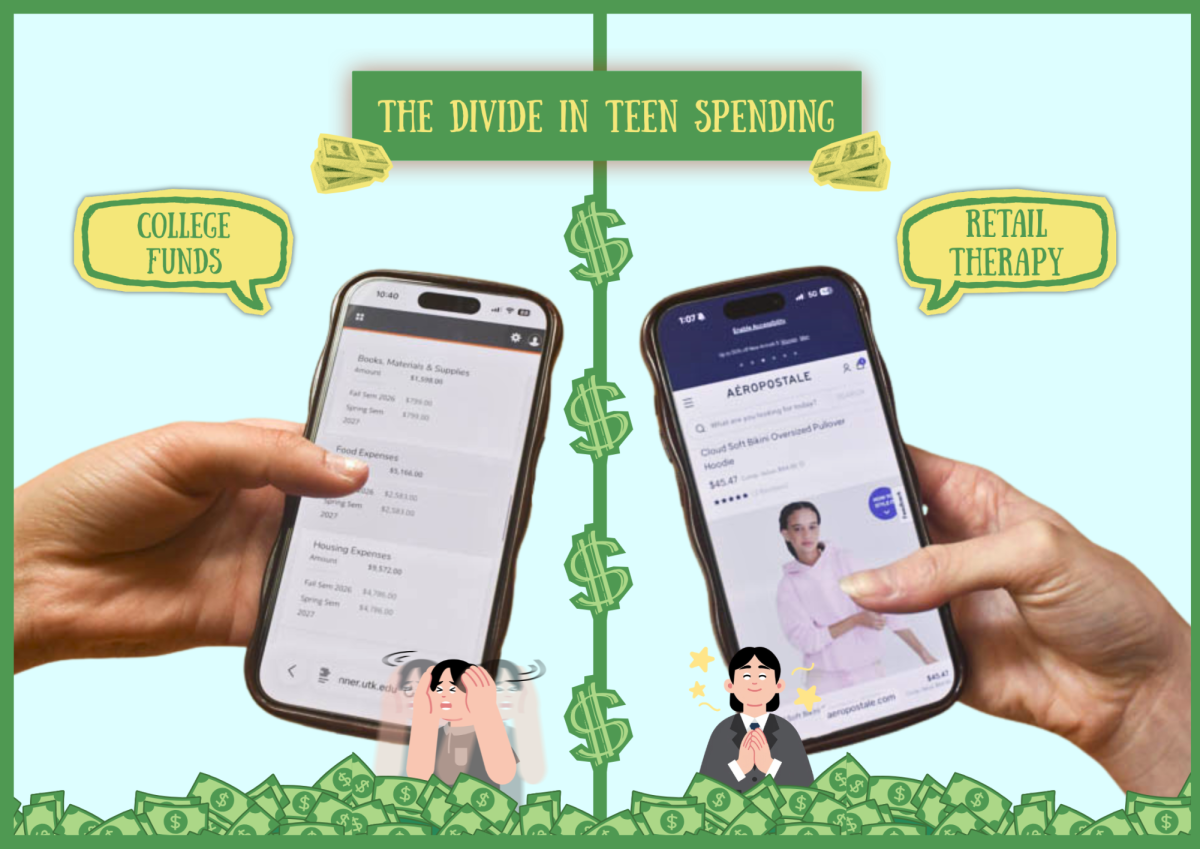
Teenage spending is often described by food, clothing, and entertainment, however financial habits may differ between age, gender, and financial independence. Many spend based on immediate wants or daily impulses over saving, while some choose to budget and save for larger and more specific investments.
“I spend a lot of money on going out for food and going shopping, probably twice a month for new clothes,” said Katelyn Johnson (12).
Some teenagers are described as being “super spenders” which is one who frequently spends in an excessive, impulsive, and even reckless manner and in some cases possibly exceeding their budget on non-essential goods. They may be driven by emotions, peer pressure, social media, or just the want for instant gratification.
“I would say I probably spend like $200 on clothes a month, but now since it’s senior stuff, I’ve ordered like $800 worth of stuff,” said Johnson.
“Two‑thirds, 64%, of parents with Gen Z children ages 18 to 28 say their children rely on them financially, whether for money, housing, or other support. More than half of those parents, 56%, say that support is straining their own finances. Nearly half of Gen Z respondents, 46%, describe their financial lives as messy, and many say they are postponing plans such as relocating, getting married, education and career changes,” according to the Wells Fargo Newsroom.
Some teenagers choose to work and manage their own finances despite having parental support, and at the same time others may heavily rely on their families for financial support. This is not an attempt to portray either approach in a negative light, but is rather a reflection of different circumstances and personal choices.
“I don’t have any obligations on what to pay for. My parents pay for like 95% of things. I don’t have any type of budget like I can go out to get food, and they pay for all my gas. Allowance, like with my clothes though yeah,” said Johnson.
“It is my choice to be more financially independent since my parents do pay for everything. They pay for all my necessities but it is my choice if I want to put it into my savings. If I want to pay for school tuition, simple classes at IVC or Saddleback, then it will be out of my pocket instead of theirs, and my parents offer but I refuse because I choose to do it on my own time and it’s my own education,” said Mailey Huynh (12).
Generation Z has been shown to favor experiential spending which is essentially preferring to invest in travelling, concerts, and events. Several teenagers and young adults have prioritized major financial priorities to attend popular events like Stage Coach and Coachella which are extremely expensive for ticket prices, places to stay, food, merchandise, and outfits.
Teenagers’ splurge on experience is often driven by social connection, authenticity, and shareable moments that are “Instagrammable” to post. Social media and cultural trends have influenced how several teenagers choose to spend their money, often splurging on experiences or materialistic trends that are reinforced through influencer culture.
“As we spend more time online, social media has become a breeding ground for unrealistic financial comparisons. Platforms such as TikTok and Instagram are full of creators pushing new trends, selling the next must-haves, and flaunting expensive hauls of luxury items. And that’s where money dysmorphia comes in,” according to Hart Ford Funds.
For some, this desire is motivated by a need for social validation and maintaining a curated online identity. Social media acts as a mirror or indicator of self worth, further encouraging a high-consumption lifestyle. While trends can foster a sense of belonging and serve as a creative outlet, it can impose risks of excessive and unsustainable spending through constant comparison.
“Lack of financial education affects all generations — including 54% of Gen Z and 67% of baby boomers — but Gen Z faces greater anxiety (59%) than boomers (29%),” according to Credit One Bank.
“I mean my parents financially supporting me will continue throughout college but not as much as I have now, and I’m getting a job to help with that…Once I get a job, it will go towards me going out or my clothes,” said Johnson.
The shift of experimental spending reflects their mindset that focuses on enjoyment and making memories rather than material goods. Although, this mindset may lead to decisions fueled by fear of missing out (FOMO) and online influence.
Furthermore, as college approaches for many teenagers, they begin to shift their focus towards major financial responsibilities such as tuition, housing, and daily life expenses. Saving for these important expenditures such as college has influenced their decisions on spending, working, and budgeting during their final years of high school. This results in cutting back on non-essential spending and purchases to emphasize more long-term financial planning over short-term wants.
“Over the last 12 months, 72% took steps to improve their financial health, such as putting money toward savings (51%) or paying down debt (24%). Nearly two-thirds (64%) focused on reducing expenses – 41% cut back on dining out and 23% shopped at more affordable grocery stores,” according to Bank of America.
“The majority of the time I will split up my paycheck into categories of spending and I will put 90% into my savings and keep the remaining for myself,” said Huynh.
Despite this, financial awareness among teenagers is growing and strategies such as budgeting, saving, and using other digital tools are becoming more common. Utilizing methods such as the 50/20/30 rule has helped them divide their income into categories based on needs, wants, and savings. The habits that teenagers use now as they begin navigating spending and saving will shape their financial capabilities in the future.