

Have you ever tried to open a website on your school-issued chromebook and been hit with a “Content Blocked” screen? If you have, you are not alone. Let’s explore why restrictions on student internet access have been implemented and what San Juan Hills High School students think about these changes.
“Website filtering is implemented primarily to ensure student safety, comply with legal requirements, and maintain an environment that supports learning” said Michael Mortenson, Manager of Network Services for Capistrano Unified School District (CUSD) via email.
CUSD’s goal in this blocking system is to form a safe and secure online environment for students, aiming to allow access to mainly educational resources on the chromebooks.In terms of discerning what content gets filtered, decisions are primarily made by Technology Information Systems (TIS) staff, District administration, and compliance requirements. TIS sets standards for technology usage of both students and instructional staff.
“We use a combination of industry-standard content categories and internal review. Categories such as explicit content, malware, phishing, and other high-risk areas are automatically blocked.”
Besides the district’s oversight on blocked content, federal law also sets limitations on Internet access by students in school settings. The Federal Communications Commission’s Children’s Internet Protection Act (CIPA) was “was enacted by Congress in 2000 to address concerns about children’s access to obscene or harmful content over the Internet” according to their website.
“[It] requires schools to block access to obscene content, child pornography, and content deemed harmful to minors in order to receive certain types of federal funding,” said Mortenson.
Some students understand why certain sites are restricted, especially ones that are clearly unrelated to school.
“The most common concern from teachers is that students are sometimes able to access gaming or other non-instructional websites,” said Mortenson.
“I get why games are blocked. If they weren’t, people would just be playing the whole class,” said Moth Golba (12).
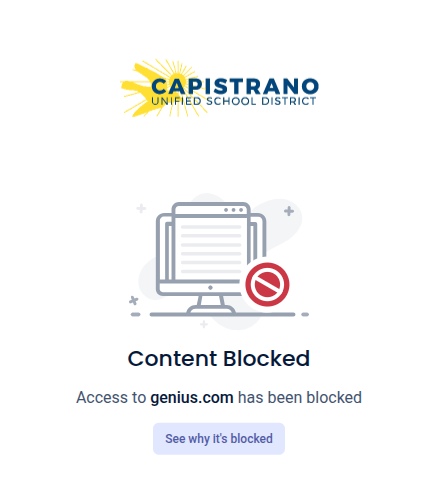
Still, others feel the filters are too strict and sometimes inconsistent.
Teachers are also running into issues, by having to change lesson plans or find alternative resources when websites they planned to use suddenly become unavailable.
“Teachers can then submit it to the TIS team for evaluation. Requests are typically reviewed promptly, and if the content is deemed appropriate for educational use, access can be granted either broadly or limited to specific users or groups, depending on the need,” said Mortenson.
The district does allow teachers to request that certain websites be unblocked, but the process can take time – sometimes longer than a single class period.
For now, the district says it will continue adjusting the system based on feedback. But as more classrooms rely on online resources, the balance between limiting distractions and allowing access to useful information is becoming harder to manage.