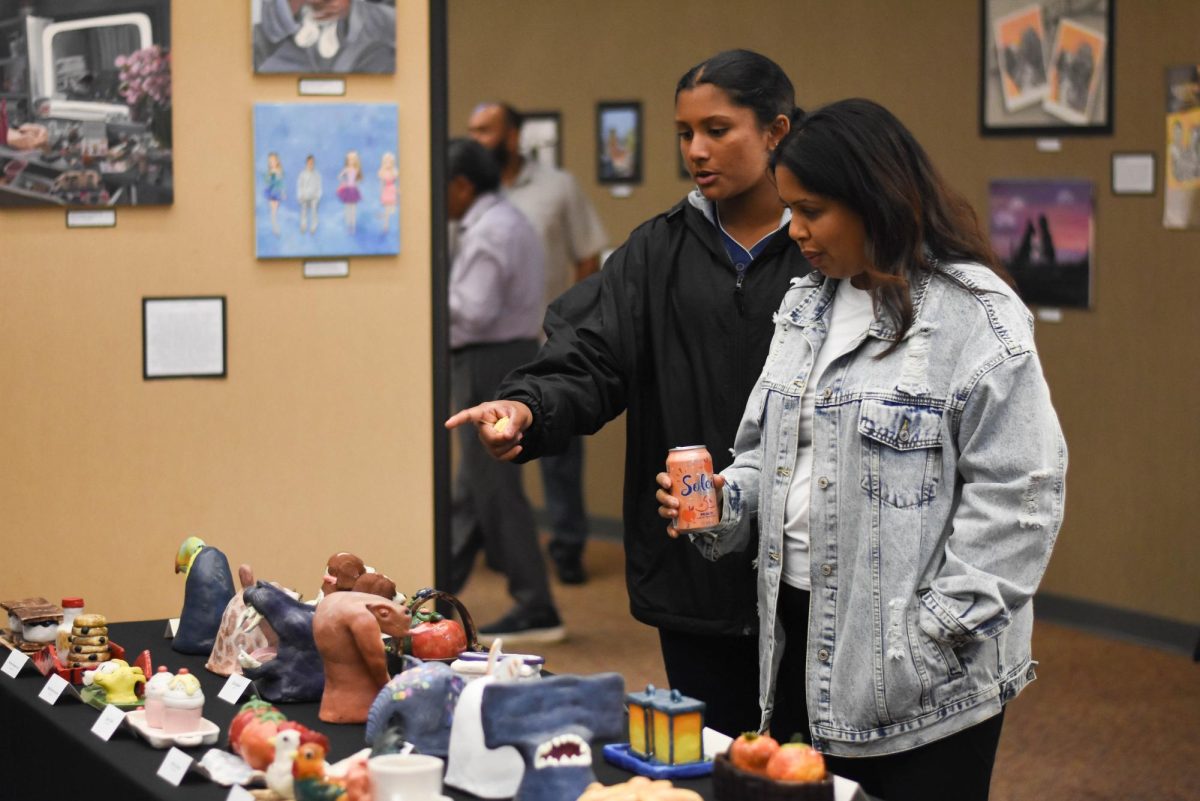
What began as months of experimentation and creativity came together in the theater conference room for this year’s AP Art exhibit. Last week, April 20 to April 24, teachers were able to take their students to the exhibit and admire the masterpieces.
Tables brimmed with exotic ceramic creations, unique canvas paintings, and multi-colored lamps were laid on display for visitors to admire. Each class took a field trip to the conference room and were able to appreciate the talent of SJHHS students.
Avery Arman is SJHHS’s AP Art teacher, who helps to guide students in creating their AP Art portfolios to submit to the College Board on May 8th. This year, students must submit 15 images of work centered on a guiding question, inquiry, or theme of their choice. In the theater conference room, students showcased several of their portfolio pieces that will be submitted for the AP test.
“How can I use a series of posters to explore the cultural significance of icons in the ‘90s?” is Match Hazen’s (11) guiding question for his AP Art portfolio this year.
Three pieces of Hazen’s were displayed in the art exhibit, all of which were inspired by ‘90s themes. One was a graphic drawing inspired by his grandfather’s company, Oakley, and another was an oil pastel eraser drawing inspired by F1 racing.
Hazen has been practicing art his entire life, and shares his passion for it with his father and brother. In the future, he hopes to possibly pursue a career in illustration.
Another AP Art student, Brandt Djurdjulov’s (11) guiding question was about showcasing the contrast between a life of fulfillment of one’s dreams versus a life of conformity to society.
As a junior in high school, Djurdjulov uses his art to express the complicated decision of following his dream of becoming an artist or conforming to society’s standards and choosing a more stable profession. Djurdjulov’s pieces represent deeper questions that many teenagers struggle to answer, which creates a more complex layer to his artwork, invoking relatability and community among viewers.
“As a kid, I always wanted to do art. I was always drawing, in the kitchen, on the walls, and as a preteen I would draw from comic books to improve my style,” said Djurdjulov.
Art has always been a part of Djurdulov’s life, and he hopes to continue this passion of his for the rest of his life.
Recently, Djurdulov submitted a painting of the San Juan Capistrano (SJC) Mission’s Greystone Church for the mission’s 250 year anniversary art contest. Senior Adriana Mora also submitted a piece of art to the same contest, of a water colored painting of the old mission and new mission basilica.
Djurdulov and Mora’s artwork were both selected to be displayed in the SJC Mission, with Djurdulov’s piece also winning first place out of every 11th grade submission that was received. Another student, Noe Palacios (10), also submitted artwork that is displayed in the Mission. Similar to Djurdulov, Palacios won first place in the competition but amongst every 10th grade student that participated.
These students’ talent and hard work is commemorated in our community, and their art will be displayed in the mission for an entire month.
Mora is also an AP Art student at SJHHS, whose portfolio is inspired by the guiding question of how a Mexican woman living in America who is the granddaughter of immigrants can express her political views safely? Her pieces are inspired by civil liberties and rights. One artwork includes the Statue of Liberty, another depicts ICE agents, and she also dedicated a piece to her mom and grandma, to honor the generations that came before her. Last year was Mora’s first time taking an art class, but she has excelled at her craft despite that.
“I really like taking the art class, because it got me out of my comfort zone, and I got to explore more political art,” said Mora about her experience in AP Art.
This year’s art exhibit honored the artists for their hard work and talent. Artists were praised even more by comment cards that viewers could write, complimenting their work and speaking on the impact it had on them. The art exhibit cultivated community and had a meaningful impact on viewers that goes beyond looking at canvases and paper.